Natural Carteret — 5 Min Read
Perfect piers
By Jessi Waugh
There aren’t many piers left along the North Carolina coast. At last count, the tally sat at eighteen, down from thirty-three in 1966. Like sand sifting through our fingers, NC piers are disappearing quickly, so let’s celebrate those that remain.
When I was a kid growing up in Carteret County, seven piers dotted Bogue Banks. Protruding from east to west were the Triple S, Oceanana, Sportsman’s, Sheraton, Iron Steamer, Indian Beach, and Bogue Inlet piers. Of those seven, two remain today – the Oceanana and Bogue Inlet.
In Atlantic Beach, we’d walk to the Sportsman’s, then “Can you make it to the next one?” – the Oceanana, then “Let’s just keep going” – the Triple S. I never realized what a luxury that was. Of course it was special – three piers within walking distance? It was pier perfection.
At the Sheraton, now the DoubleTree, surf contests were held, and sometimes still are, by a shortened version of the pier. The Iron Steamer’s shipwreck was visible at extreme low tide, and the Bogue Inlet pier restaurant featured stuffed animals dangling from its ceiling.
But the one I knew best was the Indian Beach pier because my dad lived beside it in a 1970s A-frame perched on a high dune.
Indian Beach is a small town. It’s also the only town I know of that’s cleft in two by another community. Indian Beach lies to the east of Salter Path, the oldest settlement on Bogue Banks, then after Salter Path ends, Indian Beach resumes again, stretching for about a mile to Emerald Isle. Indian Beach is a town with two ends and no middle, like a mayonnaise sandwich.
At the Indian Beach Pier, my brother and I checked out the catch and cashed in our quarters at the pier house candy machines. I got Runts, eating all the yellow bananas first. Then the red ones. Orange. Green. Purple.
What’s a pier house, you say?
A pier house is the building attached to a pier, where pier passes are sold. It has bathrooms, bait, and beer. Hot dogs and ice cream. New fishing poles and beach buckets. The essentials.
A pier house might also have a restaurant, bar, candy machines, arcade games, or pool tables. I love to shoot a game of pool in a pier house. I can’t play worth a chipped cue ball, but that doesn’t stop me from posing confidently with cue stick in hand, twisting over the table, and stink-eyeing the ball. Missed. Better chalk the cue again.
But of course, the main reason people visit piers is for the fish. A fishing license isn’t required, passes are inexpensive, and the pier is open all night long. It’s a fishing party.
Not a fisherperson? That’s OK; piers are for everyone.
For a few bucks (or for free at some piers), visitors can walk the fish-scaled wood planks and admire the sea, see the daily catch, and socialize with other pier folks.
Hundreds of visitors return seasonally to our piers to cast a line with friends and family. Piers are community hubs, connecting folks with a common love of the coast. Piers bring us together and make the ocean accessible. They’re a place to catch and to catch up.
Piers hold histories, stories, and memories. Visit a local pier soon to hear about the past, to share in the present, and to invest in the future.
There aren’t many piers left along the North Carolina coast. At last count, the tally sat at eighteen, down from thirty-three in 1966. Like sand sifting through our fingers, NC piers are disappearing quickly, so let’s celebrate those that remain.
When I was a kid growing up in Carteret County, seven piers dotted Bogue Banks. Protruding from east to west were the Triple S, Oceanana, Sportsman’s, Sheraton, Iron Steamer, Indian Beach, and Bogue Inlet piers. Of those seven, two remain today – the Oceanana and Bogue Inlet.
In Atlantic Beach, we’d walk to the Sportsman’s, then “Can you make it to the next one?” – the Oceanana, then “Let’s just keep going” – the Triple S. I never realized what a luxury that was. Of course it was special – three piers within walking distance? It was pier perfection.
At the Sheraton, now the DoubleTree, surf contests were held, and sometimes still are, by a shortened version of the pier. The Iron Steamer’s shipwreck was visible at extreme low tide, and the Bogue Inlet pier restaurant featured stuffed animals dangling from its ceiling.
But the one I knew best was the Indian Beach pier because my dad lived beside it in a 1970s A-frame perched on a high dune.
Indian Beach is a small town. It’s also the only town I know of that’s cleft in two by another community. Indian Beach lies to the east of Salter Path, the oldest settlement on Bogue Banks, then after Salter Path ends, Indian Beach resumes again, stretching for about a mile to Emerald Isle. Indian Beach is a town with two ends and no middle, like a mayonnaise sandwich.
At the Indian Beach Pier, my brother and I checked out the catch and cashed in our quarters at the pier house candy machines. I got Runts, eating all the yellow bananas first. Then the red ones. Orange. Green. Purple.
What’s a pier house, you say?
A pier house is the building attached to a pier, where pier passes are sold. It has bathrooms, bait, and beer. Hot dogs and ice cream. New fishing poles and beach buckets. The essentials.
A pier house might also have a restaurant, bar, candy machines, arcade games, or pool tables. I love to shoot a game of pool in a pier house. I can’t play worth a chipped cue ball, but that doesn’t stop me from posing confidently with cue stick in hand, twisting over the table, and stink-eyeing the ball. Missed. Better chalk the cue again.
But of course, the main reason people visit piers is for the fish. A fishing license isn’t required, passes are inexpensive, and the pier is open all night long. It’s a fishing party.
Not a fisherperson? That’s OK; piers are for everyone.
For a few bucks (or for free at some piers), visitors can walk the fish-scaled wood planks and admire the sea, see the daily catch, and socialize with other pier folks.
Hundreds of visitors return seasonally to our piers to cast a line with friends and family. Piers are community hubs, connecting folks with a common love of the coast. Piers bring us together and make the ocean accessible. They’re a place to catch and to catch up.
Piers hold histories, stories, and memories. Visit a local pier soon to hear about the past, to share in the present, and to invest in the future.
This post’s featured image was captured by Summer Flowers Ricketts. You can be a patron of the arts and purchase a print at her online art gallery here.
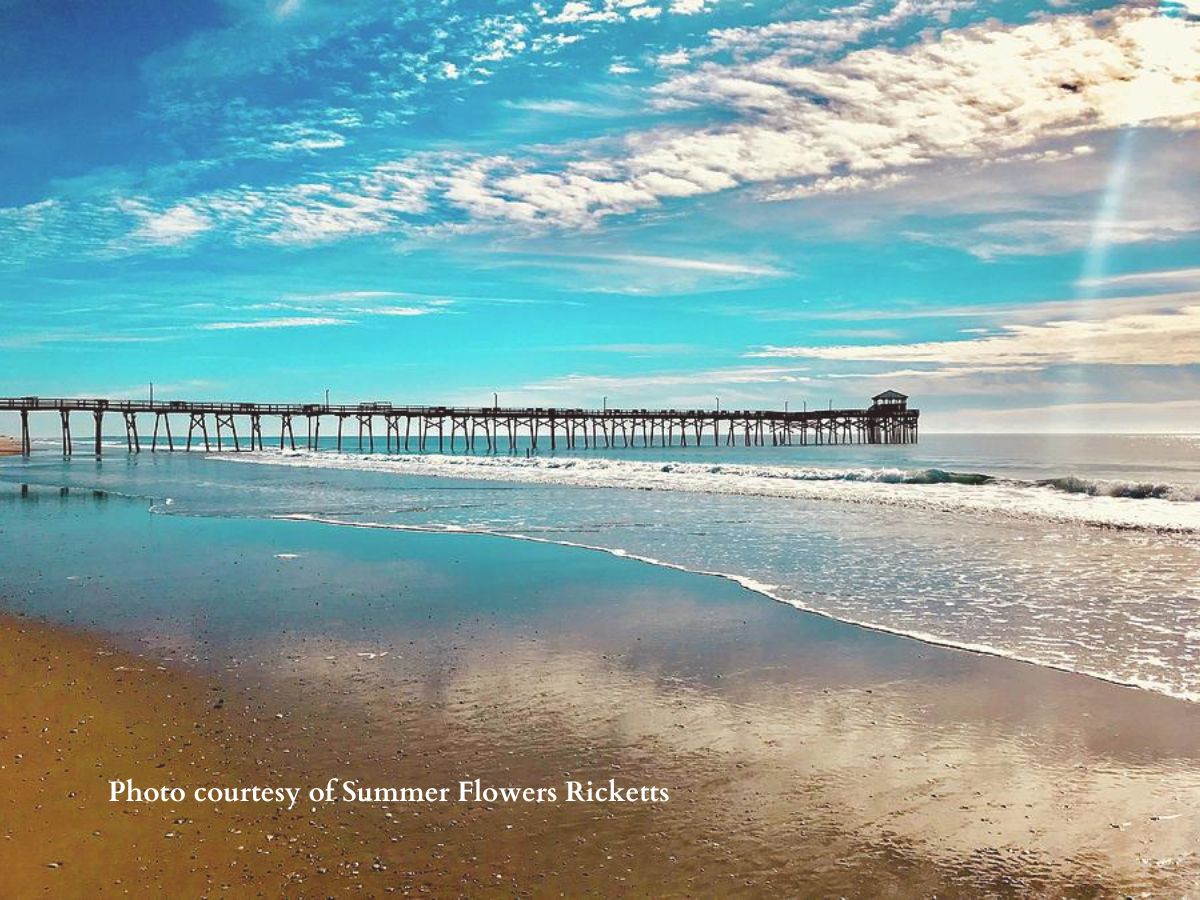
This post’s featured image was captured by Summer Flowers Ricketts. You can be a patron of the arts and purchase a print at her online art gallery here.